

Collection Agents Built for Japan’s Unique Language, Culture, and Compliance

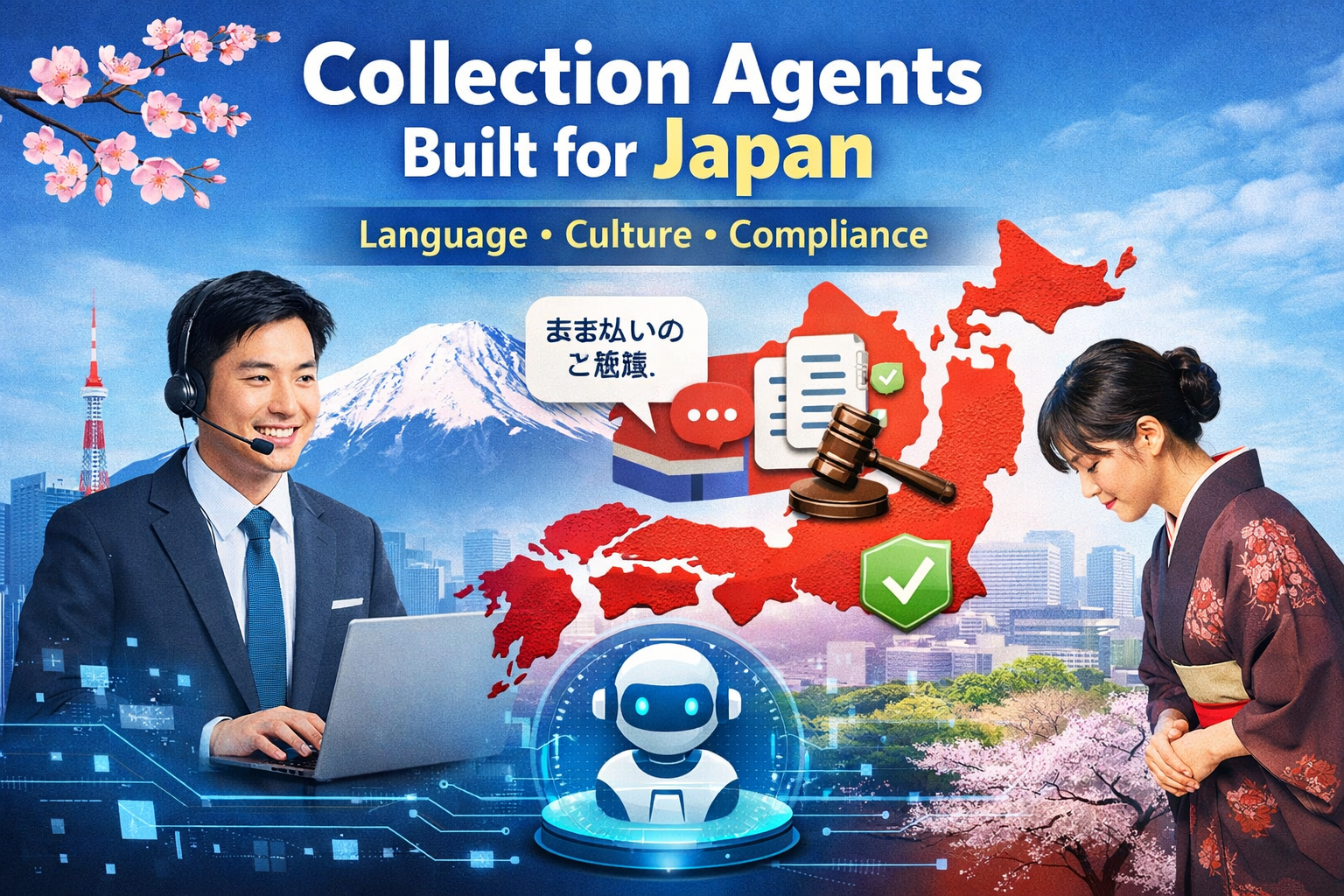

Collection Agents Built for Japan’s Unique Language, Culture, and Compliance
Introduction: Why Japan Needs a Different Kind of Collection Agent
Japan is not just another market for debt collection. It is one of the most linguistically nuanced, culturally sensitive, and compliance-driven ecosystems in the world. What works in the US, India, or Southeast Asia often fails outright in Japan. Direct scripts, aggressive follow-ups, or generic automation damage trust, reduce recovery rates, and expose enterprises to regulatory risk.
This is where next-generation collection agents purpose-built for Japan create a measurable advantage.
Modern collection agents must go beyond basic reminders and scripted calls. They must understand keigo, read contextual silence, adapt to cultural expectations around apology and obligation, and operate within Japan’s strict legal and consumer protection frameworks. When designed correctly, they do not feel like collection systems. They feel like responsible extensions of the brand.
This blog explains what truly differentiates collection agents built for Japan, why localization is non-negotiable, and how enterprises can deploy compliant, high-performing collection agents that scale across both Japan and India.
What Makes Collection Agents Effective in Japan
Language Is Not Translation. It Is Interpretation.
Japanese language operates on context, hierarchy, and intent. Literal translation of collection scripts fails because meaning in Japanese is often implied, not stated.
Effective collection agents must handle:
- Keigo variations based on customer age, status, and scenario
- Indirect refusal patterns such as “検討します” or prolonged silence
- Polite acknowledgment structures before payment intent is discussed
- Soft commitment language rather than explicit yes or no responses
Collection agents trained on native Japanese conversational data can detect intent shifts even when the customer never explicitly states agreement or refusal.
Cultural Expectations Shape Payment Behavior
In Japan, non-payment is often associated with embarrassment, not defiance. Customers avoid confrontation and expect discretion.
High-performing collection agents align with this reality by:
- Prioritizing apology-first conversation flows
- Avoiding public or repeated pressure tactics
- Offering flexible resolution paths without loss of face
- Framing repayment as responsibility rather than enforcement
This cultural alignment directly improves engagement rates and reduces call abandonment.
Compliance Is Central, Not a Feature
Japan has strict regulations governing debt collection, including:
- Consumer Contract Act
- Act on Specified Commercial Transactions
- Industry self-regulation by JCA and other bodies
Collection agents operating in Japan must:
- Enforce time-of-day calling restrictions
- Maintain precise consent and opt-out handling
- Avoid coercive language, even implicitly
- Log and audit every interaction for compliance review
Compliance-aware collection agents reduce legal exposure while improving long-term customer trust.
Why Generic Collection Agents Fail in Japan
Most legacy or globally built collection agents fail for three reasons.
One: Over-Direct Communication
Direct payment demands common in Western markets are perceived as rude or aggressive in Japan. This leads to disengagement rather than resolution.
Two: Poor Intent Detection
Japanese customers rarely state intent explicitly. Generic NLP models miss these signals, misclassifying willingness to pay as avoidance.
Three: Inflexible Automation
Rigid workflows break when customers respond indirectly or ask culturally nuanced questions. This forces escalations and increases operational cost.
Collection agents built for Japan are designed to operate in ambiguity, not fight it.
Architecture of Japan-Ready Collection Agents
Native Japanese Language Models
Effective collection agents use models trained on:
- Japanese financial and collections conversations
- Formal and informal keigo structures
- Industry-specific vocabulary used by banks, NBFCs, and telcos
This ensures accuracy in intent detection, sentiment analysis, and response generation.
Adaptive Conversation Orchestration
Instead of fixed scripts, modern collection agents use dynamic flows that adjust based on:
- Customer hesitation patterns
- Emotional tone shifts
- Repeated deferrals or indirect refusals
This allows the agent to slow down, soften language, or propose alternatives without breaking compliance.
Built-In Compliance Guardrails
Compliance is embedded at the system level, not layered on top.
Key capabilities include:
- Automatic suppression during restricted hours
- Language filters to prevent coercive phrasing
- Real-time compliance scoring during conversations
- Full audit trails for regulators and internal reviews
This makes collection agents safe to scale across Japan’s regulated environment.
Bridging Japan and India: A Unified Yet Localized Strategy
Enterprises operating across Japan and India face a unique challenge. India prioritizes scale, speed, and multilingual reach. Japan prioritizes precision, politeness, and compliance.
The solution is not separate systems. It is a unified collection agent architecture with localized intelligence.
Shared Core, Local Intelligence
Best-in-class collection agents use:
- A shared orchestration and analytics layer
- Japan-specific language and compliance modules
- India-specific multilingual and high-volume optimizations
This reduces operational complexity while respecting market differences.
Consistent Outcomes, Different Experiences
While the customer experience differs dramatically, enterprise KPIs remain aligned:
- Higher recovery rates
- Lower cost per contact
- Reduced human agent dependency
- Improved brand perception
Collection agents built this way perform across geographies without compromise.
Use Cases Across Japanese Enterprises
Banking and Financial Services
- Loan EMI reminders with polite escalation
- Credit card overdue management
- Structured hardship conversations
Telecommunications
- Postpaid bill recovery
- Service suspension warnings with cultural sensitivity
- Payment plan negotiation
Utilities and Subscription Services
- Late payment nudges
- Gentle follow-ups without brand damage
- Automated dispute handling
In each case, collection agents act as trusted intermediaries, not enforcers.
SEO Perspective: Why “Collection Agents” Must Be Localized
For Japan SEO, relevance matters more than keyword density.
High-ranking content aligns with:
- Local search intent in Japanese and English
- Industry-specific phrasing used by enterprises
- Trust signals around compliance and reliability
By focusing on collection agents designed for Japan, enterprises signal credibility to both search engines and buyers.
For India, the same keyword signals scale, AI capability, and operational efficiency. A well-structured narrative bridges both markets without dilution.
The Future of Collection Agents in Japan
The next generation of collection agents will:
- Anticipate payment behavior using contextual intelligence
- Shift from reactive collections to proactive prevention
- Integrate voice, chat, and messaging channels seamlessly
- Operate as always-on, compliant digital agents
In Japan, success will belong to systems that respect culture as much as they respect technology.
Final Takeaway
Japan is not a market where generic automation wins. It is a market where respect, precision, and compliance define outcomes.
Collection agents built specifically for Japan’s language, culture, and regulatory environment consistently outperform legacy systems and human-only teams. When architected correctly, they also scale effortlessly across India and other high-growth markets.
For enterprises serious about recovery, reputation, and long-term customer relationships, Japan-ready collection agents are not optional. They are foundational.


