

How Voice AI is Making Shopping Accessible in Tier 2 Cities


Introduction
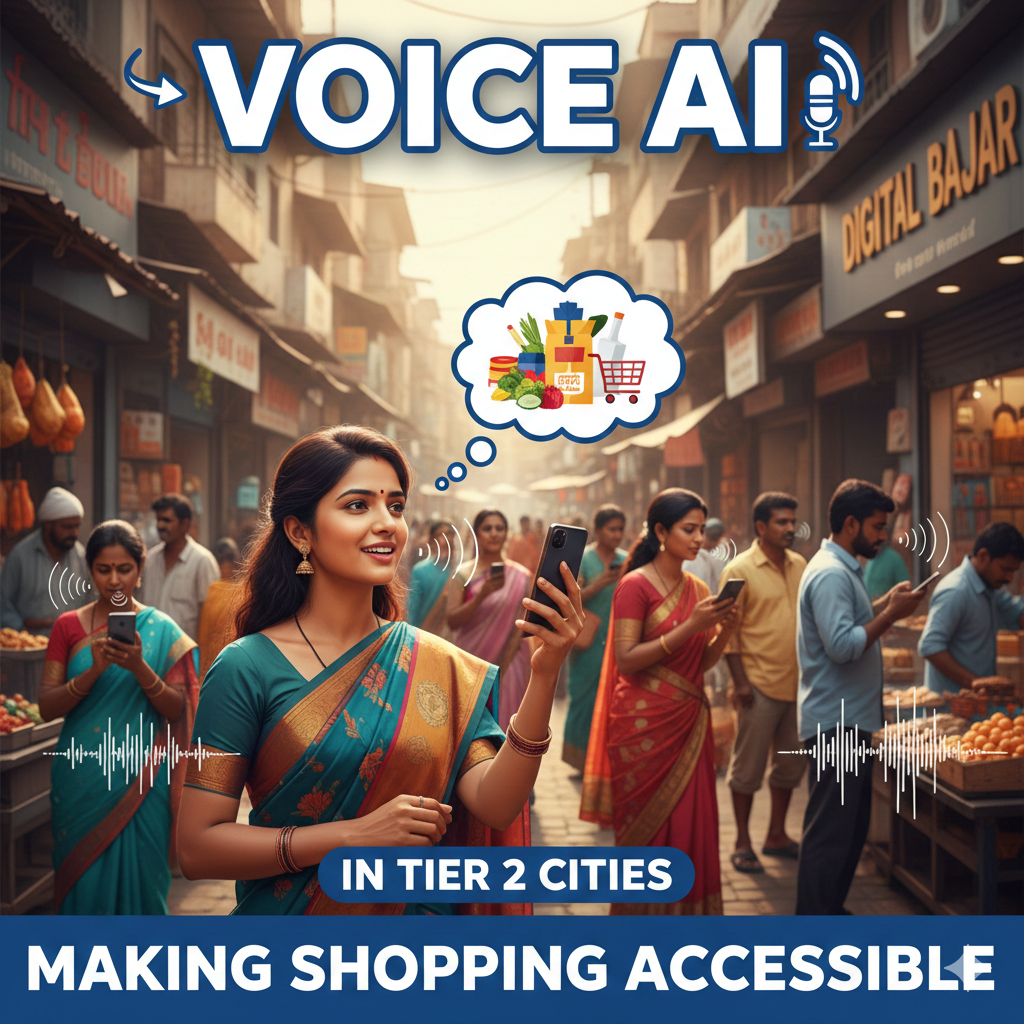
Picture yourself trying to navigate a shopping app that's entirely in a language you're not comfortable with. Now imagine doing this while balancing daily work, family responsibilities, and limited digital experience. This is the reality for millions of shoppers in India's Tier 2 cities who want to shop online but face significant language and accessibility barriers.
Voice AI is changing this narrative dramatically. From small towns in Rajasthan to emerging cities in Madhya Pradesh, AI shopping assistants are enabling conversations in local languages, making e-commerce as simple as talking to a shopkeeper. In this blog, we'll explore how voice assistants India are democratizing online shopping access, the challenges they're solving, and why this technology represents the future of inclusive commerce.
Understanding the Tier 2 City Landscape
India's Tier 2 cities are home to over 300 million people and represent one of the fastest-growing consumer markets globally. Cities like Indore, Nagpur, Lucknow, Jaipur, and Coimbatore are witnessing unprecedented digital adoption, yet they face unique challenges that differentiate them from metropolitan areas.
The e-commerce boom in these regions is undeniable. According to recent industry reports, Tier 2 and Tier 3 cities contributed 65% of festive orders in 2025, with Tier 3 alone accounting for 46% of total orders. During the 2025 summer sales, these cities drove a 21% year-over-year growth, significantly outpacing metropolitan areas. Even more striking, 60-65% of online shoppers during festive sales came from Tier 2 cities, demonstrating their growing influence on India's digital economy.
The numbers tell a compelling story about shifting consumption patterns. India's e-retail market, valued at approximately $60 billion in 2024, is projected to reach $170-190 billion by 2030, with almost three out of every five new online shoppers since 2020 emerging from Tier 3 and smaller cities. This growth trajectory is reshaping how businesses think about market expansion and customer engagement.
What makes Tier 2 cities particularly interesting is their demographic composition. These markets consist primarily of young, mobile-first users who are digitally curious but may lack the English proficiency or typing comfort that traditional e-commerce interfaces assume. Many residents are first-time internet users navigating smartphones for essential services like shopping, banking, and government assistance. The linguistic diversity is enormous, with shoppers preferring to interact in Hindi, Tamil, Telugu, Marathi, Gujarati, and numerous other regional languages.
Key Challenges Facing Tier 2 Shoppers
Despite the explosive growth potential, Tier 2 city consumers encounter several obstacles that prevent seamless online shopping experiences. Understanding these challenges is crucial to appreciating how voice AI creates transformative impact.
Language Barriers and Digital Literacy
English-centric interfaces remain the primary barrier to e-commerce adoption in smaller cities. While metropolitan users navigate apps effortlessly, Tier 2 shoppers often struggle with terminology, navigation menus, and product descriptions written entirely in English. India's adult literacy rate stands at 73.2%, meaning approximately 370 million adults lack reading skills, making text-heavy interfaces essentially inaccessible.
Even among literate users, comfort with English varies dramatically. A shopkeeper in Kanpur might speak fluent Hindi but struggle to search for "cotton kurtas with embroidery" in English. This language gap creates friction at every touchpoint, from product discovery to checkout, resulting in abandoned carts and lost sales opportunities.
Digital literacy compounds these challenges. Many Tier 2 users own smartphones but lack experience with app-based shopping. Complex checkout processes, multiple form fields, and unclear navigation paths feel overwhelming. The gap between technological potential and actual accessibility becomes evident, particularly in rural areas where digital literacy is only 25%.
Limited Text Input Capabilities
Typing on smartphones presents physical and practical challenges. Hindi, Tamil, Telugu, and other Indian language keyboards require switching between scripts, special characters, and phonetic input methods that slow down the shopping experience. For users accustomed to verbal communication, typing queries feels unnatural and time-consuming.
Voice AI addresses this fundamental mismatch between user preference and interface design. Speaking is not just faster it's the most natural mode of communication for humans. Research indicates that voice search adoption has grown significantly, with over 55% of Indian internet users now leveraging voice search regularly, particularly on a weekly basis for commerce-related activities.
Trust and Confidence Issues
First-time online shoppers in Tier 2 cities often harbor legitimate concerns about product quality, payment security, and delivery reliability. Without the ability to communicate clearly with customer support or understand return policies written in English, these anxieties intensify. The inability to ask questions naturally creates hesitation at critical decision-making moments.
Traditional chatbots offering scripted responses fail to address nuanced concerns. A shopper might want to know whether a saree's actual color matches the photo, whether a product is suitable for a specific climate, or how to handle a size exchange. These queries require conversational depth that text-based interfaces rarely provide effectively.
Infrastructure and Connectivity Constraints
While improving rapidly, connectivity in Tier 2 cities remains inconsistent compared to metropolitan fiber networks. Data costs, though among the world's lowest at approximately $0.09 per GB, still matter for price-conscious consumers. Heavy, image-laden shopping apps consume significant data and struggle with load times on slower networks.
Voice interfaces offer a practical solution. Voice data packets are substantially smaller than video or high-resolution images, making voice-enabled shopping experiences feasible even on 3G networks or feature phones. This technical advantage directly impacts accessibility for users with limited connectivity or older devices.
How Voice AI Solves These Challenges
Voice AI technology represents a paradigm shift in making e-commerce genuinely accessible to India's diverse linguistic and demographic landscape. Modern AI shopping assistants leverage sophisticated natural language processing, speech recognition, and multilingual capabilities to transform how Tier 2 shoppers discover, evaluate, and purchase products.
Natural Language Product Search
Voice-enabled product search eliminates the typing barrier entirely. Instead of struggling to spell "refrigerator" or navigate complex category menus, a shopper in Nashik can simply say "Mujhe ek budget-friendly fridge dikhao" (Show me a budget-friendly fridge). The voice AI understands the intent, processes the query in the user's native language, and presents relevant results immediately.
This capability extends beyond simple keywords. Advanced voice AI platforms comprehend context, handle code-switching between Hindi and English (Hinglish), and interpret colloquial expressions. When someone asks for "bacchon ke liye school bag under 500 rupees" (school bags for kids under 500 rupees), the system understands the price constraint, target demographic, and product category simultaneously.
According to industry data, Hindi voice searches alone have surged by 400% in recent years, reflecting the massive demand for vernacular interfaces. Voice AI platforms now support over 20 major Indian languages with high accuracy, breaking down barriers for millions who were previously excluded from digital commerce.
Real-Time Abandonment Recovery
Cart abandonment rates in e-commerce typically hover around 70%, with language and complexity being significant contributing factors. Voice AI enables proactive engagement when customers show signs of hesitation. If a user adds products to their cart but doesn't proceed to checkout, the system can initiate a voice call in their preferred language within minutes.
These abandonment callback conversations feel natural and supportive. The AI shopping assistant might say "Namaste, main dekh rahi hoon aapne kuch items cart mein add kiye hain. Kya main aapki koi madad kar sakti hoon?" (Hello, I see you've added some items to your cart. Can I help you with anything?). This personalized outreach addresses concerns, explains offers, and guides users through checkout, recovering sales that would otherwise be lost.
Voice-Enabled Payment Recovery
Payment failures frustrate both merchants and customers, particularly when users don't understand why transactions fail. Voice AI transforms payment failure recovery by immediately reaching out to affected customers. Rather than sending a generic SMS that might be ignored or misunderstood, the system places a voice call explaining what happened in simple, regional language.
The voice assistant can guide users through alternative payment methods, verify card details verbally if needed, provide UPI payment links through conversational interactions, or arrange cash-on-delivery if digital payments remain problematic. This human-like assistance significantly improves successful transaction completion rates.
Conversational Order Tracking
"Mera order kahan hai?" (Where is my order?) is one of the most common post-purchase queries. Voice AI enables order tracking through simple voice commands where customers can say their order ID or verify identity through voice biometrics. The assistant provides real-time updates about shipment location, expected delivery time, and any delays with explanations.
This eliminates the need to navigate tracking interfaces, remember login credentials, or decipher courier company websites. Voice-based tracking is particularly valuable during peak shopping seasons when customer service teams face overwhelming query volumes.
Seamless Return and Exchange Management
Returns and exchanges intimidate first-time online shoppers who worry about complicated processes. Voice AI simplifies this entirely by managing the complete workflow conversationally. A customer can initiate a return by calling and explaining the issue in their own words: "Yeh kurta size chhota hai, mujhe exchange chahiye" (This kurta is too small, I need an exchange).
The AI assistant confirms the order details, explains the return policy in simple language, offers replacement options, and schedules pickup at the customer's convenience. The system handles pickup scheduling automatically, integrating with logistics partners to arrange timely collection. This frictionless experience builds trust and encourages repeat purchases.
Fraud Prevention Through Voice Verification
Security concerns plague online transactions, especially in markets where digital fraud awareness is growing. Voice AI introduces an additional authentication layer through voice biometrics. Each person's voice has unique characteristics that can verify identity more naturally than remembering complex passwords.
For high-value transactions or account changes, the system can request voice verification: "Please say 'I authorize this transaction'" in the registered language. This approach balances security with user-friendliness, protecting customers without creating obstacles.
Address and PIN Validation
Incorrect or incomplete addresses cause delivery failures and customer dissatisfaction. Voice AI proactively validates delivery information by calling customers to confirm address details, clarify landmark references that might be unclear in text, and verify PIN codes verbally. This is particularly valuable in Tier 2 cities where informal address systems (near the temple, opposite the school) are common.
The assistant can ask clarifying questions like "Kya aap railway station ke paas wali colony mein rehte hain?" (Do you live in the colony near the railway station?) to ensure accurate delivery. This conversational verification dramatically reduces return-to-origin rates.
Real-World Applications and Use Cases
Voice AI's theoretical advantages come alive through specific applications that e-commerce platforms are deploying across Tier 2 markets. These use cases demonstrate how technology translates into tangible business outcomes and improved customer experiences.
Flash Sale Alerts and Engagement
Flash sales drive significant traffic and revenue but require timely customer notification. Voice AI enables proactive outreach in regional languages, alerting shoppers about upcoming sales, exclusive deals on products they've previously viewed, and limited-time offers. The personal touch of a voice call generates higher engagement rates than SMS or push notifications that often go unnoticed.
A shopper interested in electronics might receive a call: "Namaskar, kal shaam 6 baje se smartphones par 40% discount shuru ho raha hai. Kya main aapko remind kar doon?" (Hello, tomorrow evening at 6 PM we're starting a 40% discount on smartphones. Should I remind you?). This creates anticipation and drives participation.
Cash-on-Delivery Confirmation
Cash-on-delivery remains the preferred payment method for many Tier 2 shoppers who are cautious about online transactions. COD confirmation calls reduce delivery failures by verifying that customers will be available to receive orders and have the required cash amount. The voice assistant can confirm "Aapka order kal 2-5 PM ke beech aa raha hai, kya aap ghar par honge?" (Your order is arriving tomorrow between 2-5 PM, will you be at home?).
These proactive confirmations reduce wasted delivery attempts, optimize logistics routing, and improve customer satisfaction by ensuring successful handovers. According to logistics data, RTO (Return to Origin) rates are significantly higher in Tier 2 and Tier 3 cities due to address and behavioral factors—voice confirmation helps mitigate this challenge.
Post-Purchase Feedback Collection
Customer feedback is essential for improving products and services, but traditional survey methods face low response rates. Voice AI conducts feedback collection through natural conversations that feel less formal than online forms. After a successful delivery, the assistant might call and say "Aapka order kaisa laga? Kya product quality achchi thi?" (How was your order? Was the product quality good?).
These conversations generate valuable NPS (Net Promoter Score) data while making customers feel heard. Voice feedback also captures nuanced sentiments that multiple-choice questions miss, providing richer insights for product and service improvements.
Warranty Claim Initiation
Warranty claims confuse many customers who don't understand eligibility criteria or required documentation. Voice AI guides users through the entire warranty claim process conversationally. When a customer calls about a defective product, the assistant verifies the purchase date, explains warranty coverage, collects necessary information through natural dialogue, and initiates the claim automatically.
This removes friction from after-sales service, a critical factor in building long-term customer relationships. Satisfied warranty experiences drive brand loyalty and reduce negative reviews.
While voice AI offers tremendous potential, successful deployment requires addressing technical, operational, and user experience challenges specific to Tier 2 markets.
Handling Diverse Dialects and Accents
India's linguistic diversity extends beyond major languages to thousands of dialects and regional variations. A Hindi speaker in Lucknow sounds different from one in Jaipur, and Tamil dialects vary significantly between Madurai and Coimbatore. Voice AI platforms must achieve high accuracy across this spectrum.
Solution approaches include continuous model fine-tuning with regional speech data, real-time adaptation that learns individual user speech patterns within seconds, and fallback mechanisms that request clarification when confidence levels drop. Leading platforms achieve accuracy rates exceeding 90% across major Indian languages and dialects.
Network Reliability Issues
Inconsistent connectivity in Tier 2 cities can disrupt voice interactions if not managed properly. Voice AI systems must be designed for graceful degradation, maintaining functionality even with network interruptions.
Implementation strategies include audio buffering and resumption protocols, automatic conversation state saving, and alternative channel switching (voice to SMS to WhatsApp) when voice connectivity fails. These resilience features ensure users aren't frustrated by technical limitations beyond their control.
Building User Trust and Awareness
Many Tier 2 shoppers are unfamiliar with AI voice assistants and may initially distrust automated systems. Overcoming this requires patient onboarding experiences, transparent communication about AI capabilities and limitations, and seamless human escalation when needed.
Educational campaigns demonstrating voice shopping through relatable scenarios, celebrity endorsements in regional languages, and progressive feature introduction help build familiarity and confidence over time. The key is positioning voice AI as an assistant rather than a replacement for human interaction.
Data Privacy and Security
Voice data contains sensitive personal information requiring robust protection. ISO 27001:2022, ISO 27701, and SOC 2 Type II certifications are essential for enterprise deployments. TRAI compliance for telecom-grade deployments ensures adherence to Indian regulatory requirements.
Privacy-conscious implementation includes encrypted transmission and storage, data minimization principles that retain only necessary information, clear consent mechanisms, and local data residency in India-based servers. These measures protect users while building trust in voice-based commerce.
Conclusion
Voice AI represents more than technological innovation it's a democratization movement making digital commerce genuinely accessible to hundreds of millions of Indians previously excluded by language and interface barriers. In Tier 2 cities from Gujarat to West Bengal, voice shopping assistants are transforming how people discover products, make purchases, and access customer support.
The evidence is compelling: Tier 2 and Tier 3 cities now contribute over 60% of India's e-commerce growth, with voice-enabled platforms showing 3x higher conversion rates and 58% shorter sales cycles. As smartphone adoption accelerates, regional language content dominates, and voice technology matures, the convergence creates unprecedented opportunities.
For businesses, the imperative is clear. Voice AI isn't a future consideration it's a present necessity for serving India's emerging consumer class. Companies that embed natural language voice interfaces throughout the shopping journey will capture disproportionate market share in the world's fastest-growing e-commerce market. Those that don't risk irrelevance in markets that speak, not type, their way to digital commerce.
The future of shopping in India is conversational, multilingual, and voice-first. Tier 2 cities aren't just adopting this future they're defining it.
Frequently Asked Questions
1. What is an AI shopping assistant and how does it work?
An AI shopping assistant is a voice-enabled software that uses artificial intelligence to help customers shop online through natural conversations. It leverages speech recognition to understand spoken queries, natural language processing to comprehend intent and context, and machine learning to provide relevant product recommendations. In the Indian context, these assistants support multiple regional languages, allowing users to search for products, place orders, track shipments, and get customer support by simply speaking in their preferred language.
2. Which languages do voice assistants India support for e-commerce?
Modern voice AI platforms for Indian e-commerce support 20+ major regional languages including Hindi, Tamil, Telugu, Marathi, Gujarati, Bengali, Kannada, Malayalam, Punjabi, and Odia. Advanced systems also handle code-switching (Hinglish combinations) and regional dialects within these languages. This multilingual capability is crucial because over 65% of Indian users prefer interacting in their native language, and voice search in Hindi alone has surged by 400% in recent years.
3. How does voice AI reduce cart abandonment in Tier 2 cities?
Voice AI tackles cart abandonment through proactive, personalized interventions. When the system detects a customer has added items but not completed checkout, it initiates an outbound call in the customer's preferred language within minutes. The AI shopping assistant addresses concerns, clarifies doubts about products or delivery, explains payment options, and guides users through checkout step-by-step. This human-like assistance recovers sales that would otherwise be lost, with platforms reporting up to 35% higher purchase intent when regional language voice support is available.
4. Is voice shopping secure for online transactions?
Yes, voice shopping platforms implement multiple security layers including voice biometric authentication that verifies identity through unique voice characteristics, end-to-end encryption for all voice data transmission, tokenized payment processing that never exposes card details, and compliance with ISO 27001 and SOC 2 security standards. Many platforms also use voice verification for high-value transactions, where users confirm purchases by speaking specific phrases. This combination provides security comparable to or exceeding traditional text-based interfaces.
5. What are the cost benefits of implementing voice AI for e-commerce businesses?
Voice AI delivers substantial cost savings through automation. E-commerce brands report 40-70% reductions in customer support costs after deploying voice AI for routine inquiries. The technology handles unlimited simultaneous conversations, eliminating the need to scale human teams proportionally with growth. Voice AI costs approximately ₹5-14 per minute depending on volume, while human agents cost ₹20,000-40,000 monthly regardless of call volume. Additional savings come from reduced cart abandonment, lower return-to-origin rates through address verification, and decreased training costs since AI doesn't require ongoing human resource development.
6. How accurate is voice AI with regional Indian accents?
Leading voice AI platforms achieve 90%+ accuracy across major Indian languages and regional accents. This high performance results from training on millions of hours of diverse Indian speech data, continuous model refinement based on real-world interactions, and adaptive systems that learn individual user speech patterns within seconds. The technology effectively handles background noise, varying audio quality, and dialect variations. While accuracy was a limitation in earlier voice systems, modern AI-powered platforms have largely overcome this challenge, making voice interfaces reliable for commercial deployment.
7. Can voice AI work on feature phones or only smartphones?
Voice AI works on both smartphones and feature phones, making it accessible across economic segments. Basic IVR-based voice systems function on any phone with calling capability, while more advanced conversational AI works on smartphones with internet connectivity. Interestingly, smart feature phones (costing around $25) are bridging this gap, providing internet access at affordable price points. Voice data packets are also substantially smaller than image or video data, meaning voice interactions work effectively even on 3G networks or with limited data plans, addressing connectivity constraints in many Tier 2 areas.
8. How does voice AI help with product discovery in regional languages?
Voice AI transforms product discovery by allowing natural language searches in any supported regional language. Instead of typing exact keywords, users can describe what they need conversationally: "Mujhe ek budget-friendly fridge dikhao" (Show me a budget-friendly fridge). The system understands intent, extracts relevant parameters (product category, price range), and presents appropriate results. It handles synonyms, colloquialisms, and code-switching, making search intuitive. Users can refine results through follow-up questions like "Isse sasta option hai kya?" (Is there a cheaper option?), creating a guided shopping experience similar to talking with a helpful store assistant.


