

Is Normal Voice AI Just Siri with Better Marketing?

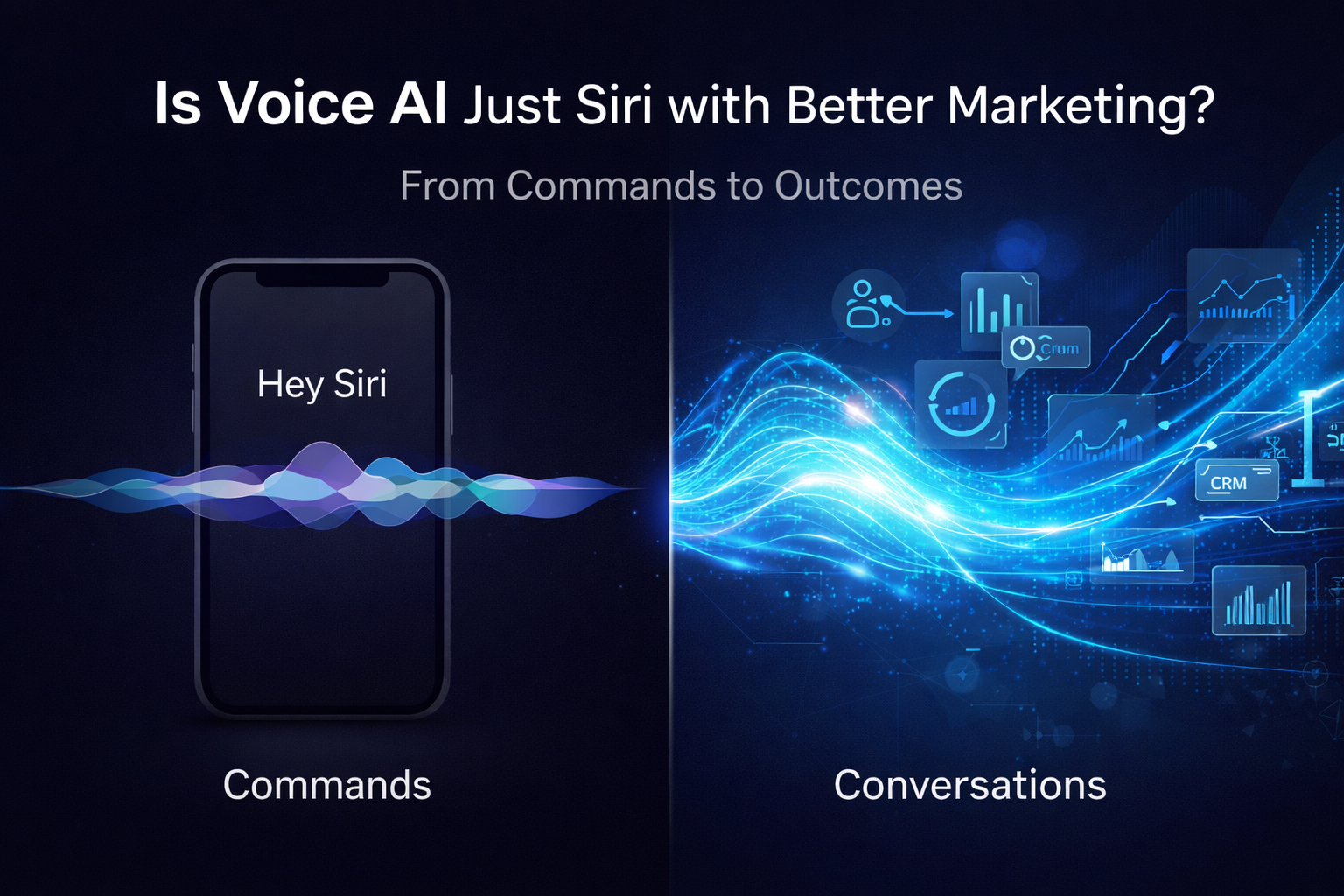

Is Normal Voice AI Just Siri with Better Marketing?
For over a decade, Siri has been the default mental model for voice AI. Say “Hey Siri,” ask it to open Instagram, set a reminder, or play a song, and that is where most conversations about voice technology end. This perception has quietly limited how enterprises, product leaders, and even consumers evaluate the real potential of modern voice AI.
The question being asked more frequently now is blunt and fair: Is normal voice AI just Siri with better marketing?
The short answer is no.
The long answer explains why Siri represents the first generation of voice assistants, while modern voice AI systems operate in a completely different category altogether. This difference is not cosmetic, not branding-led, and not incremental. It is architectural, contextual, and economic.
This article breaks that down clearly, using Siri as the reference point, because that is how most people still discover, search, and think about voice AI.
Why Siri Became the Face of Voice AI
Siri earned its position. It was the first voice assistant to achieve mass adoption at a global scale. It normalized speaking to machines. Phrases like “hey siri open instagram”, “hey siri open the youtube”, and “hey siri instagram open” are now among the most searched voice queries globally.
This is important for SEO and perception.
When people search:
- hey siri open instagram
- how to use siri shortcuts
- hey siri open the free fire
- hey siri open the instagram
they are not just searching for Siri. They are searching for voice control as a concept.
Siri became synonymous with:
- Hands-free interaction
- Basic intent recognition
- Device-level automation
But being first does not mean being sufficient.
The Core Limitation of Siri That No One Talks About
Siri was designed as a personal device assistant, not as an enterprise-grade conversational system.
That single design decision defines everything that follows.
Siri is optimized for:
- Single-user context
- Short, atomic commands
- Device-level actions
- Stateless interactions
Siri struggles with:
- Multi-turn conversations
- Business workflows
- Domain-specific reasoning
- Outcome-driven interactions
- High-volume concurrency
- Revenue-impacting use cases
This is not a flaw. It is a scope decision.
Siri is very good at opening apps. It is not designed to close outcomes.
Why “Hey Siri Open Instagram” Is the Ceiling, Not the Goal
Search behavior tells the truth.
Queries like:
- hey siri open instagram
- hey siri instagram open
- hey siri open the instagram
all indicate the same thing. Users expect command execution, not conversation.
Siri listens. Siri triggers. Siri exits.
There is no memory.
There is no persuasion.
There is no intelligence loop.
Now compare that to modern voice AI used in businesses.
A business voice AI does not just open something. It:
- Identifies intent
- Asks clarifying questions
- Retains context across turns
- Applies business rules
- Integrates with systems
- Drives an outcome
Opening Instagram is an action.
Converting a lead is a process.
Siri stops at actions.
What “Normal Voice AI” Actually Means Today
The phrase “normal voice AI” is misleading.
What most people call normal voice AI today is actually third-generation conversational AI, built on:
- Large or domain-optimized language models
- Real-time speech-to-speech pipelines
- Context retention across turns
- Intent-to-action orchestration
- System-level integrations
This is not Siri with polish. This is a different product category.
Modern voice AI is designed to:
- Handle thousands of concurrent calls
- Speak in multiple languages fluently
- Adapt tone based on sentiment
- Operate twenty four seven
- Learn from outcomes, not commands
Siri was never meant to do this.
The Siri Shortcuts Trap
One of the most searched queries related to Siri is “how to use siri shortcuts”.
This is revealing.
Shortcuts are Apple’s way of extending Siri without redesigning it. They allow users to predefine flows. But these flows are:
- Static
- Manually configured
- User-specific
- Non-adaptive
Shortcuts do not think.
They execute.
In contrast, modern voice AI systems:
- Dynamically decide the next step
- Handle interruptions
- Recover from errors
- Escalate intelligently
- Learn from prior conversations
Shortcuts are workflows.
Voice AI is reasoning.
The Marketing Illusion: Why People Think Voice AI Is Just Siri Repackaged
The confusion comes from surface-level similarities.
Both:
- Use speech
- Respond in natural language
- Are activated by voice
But this is where similarity ends.
This is like comparing:
- A calculator to a financial modeling platform
- A contact list to a CRM
- A map app to a logistics optimizer
Siri is a consumer convenience layer.
Voice AI is an enterprise automation layer.
Marketing did not blur this line. Lack of education did.
Where Siri Completely Breaks Down for Businesses
Let us be precise.
Siri cannot:
- Qualify a sales lead
- Collect structured data over a conversation
- Handle objections
- Switch languages mid-call
- Comply with regulatory scripts
- Integrate with CRMs in real time
- Measure conversion rates
- Optimize for revenue
A modern voice AI can do all of this by design.
This is why enterprises do not deploy Siri-like systems. They deploy voice agents that are:
- Trained on domain data
- Configured with business logic
- Integrated into workflows
- Measured by KPIs
This is not marketing. This is economics.
Voice AI Is Moving from Commands to Conversations
The biggest shift happening right now is subtle but decisive.
Voice AI is moving from:
- “Do this”
to - “Let us solve this”
Siri operates in a command-response loop.
Modern voice AI operates in a conversation-resolution loop.
That difference enables:
- Sales conversations
- Support conversations
- Collections conversations
- Onboarding conversations
- Retention conversations
You do not say “hey siri open the youtube” to resolve a billing issue.
You need a system that understands:
- What the user wants
- Why they want it
- What constraints exist
- What outcome is optimal
Siri was never designed for this layer.
Why Voice AI Is Becoming the Default Interface
Text-based automation has plateaued.
Chatbots work, but:
- They require attention
- They slow down resolution
- They exclude non-digital users
Voice removes friction.
This is why voice AI is winning in:
- BFSI
- Telecom
- Healthcare
- Logistics
- Retail
- Gaming
- Local services
People already speak.
Voice AI meets them where they are.
Siri proved voice works.
Modern voice AI proves voice scales.
The Economics Siri Cannot Touch
Siri is not evaluated on ROI.
Voice AI is.
Enterprises measure:
- Cost per conversation
- Call containment rate
- Conversion uplift
- Resolution time
- Agent deflection
- Compliance accuracy
A voice AI that reduces call center cost by forty percent is not “better marketing.” It is a balance sheet decision.
Siri does not operate on balance sheets.
Why Search Trends Still Orbit Siri
Despite all this, search behavior still centers on Siri.
Why?
Because Siri is the entry point.
Just like:
- Google became synonymous with search
- Zoom became synonymous with video calls
Siri became synonymous with voice.
That does not mean it defines the category.
It means it introduced it.
Voice AI Beyond Siri: What Actually Matters Now
The next phase of voice AI is defined by:
- Real-time speech-to-speech models
- Latency below human perception
- Emotional intelligence
- Context carryover across sessions
- Proactive engagement
- Autonomous decisioning
This is not about opening apps.
This is about running businesses.
Final Answer: Is Voice AI Just Siri with Better Marketing?
No.
Siri is the proof of concept.
Voice AI is the production system.
Siri showed the world that talking to machines is natural.
Modern voice AI shows enterprises that talking to machines is profitable.
If Siri was the beginning of voice, then today’s voice AI is the infrastructure layer powering the next decade of customer interaction.
Treating them as the same is not skepticism.
It is underestimating how far the technology has already moved.
Voice AI is not trying to replace Siri.
It is solving problems Siri was never built to handle.
And that distinction matters.
A lot.


