Voice Sentiment Analysis In Call Centers: A Complete Guide

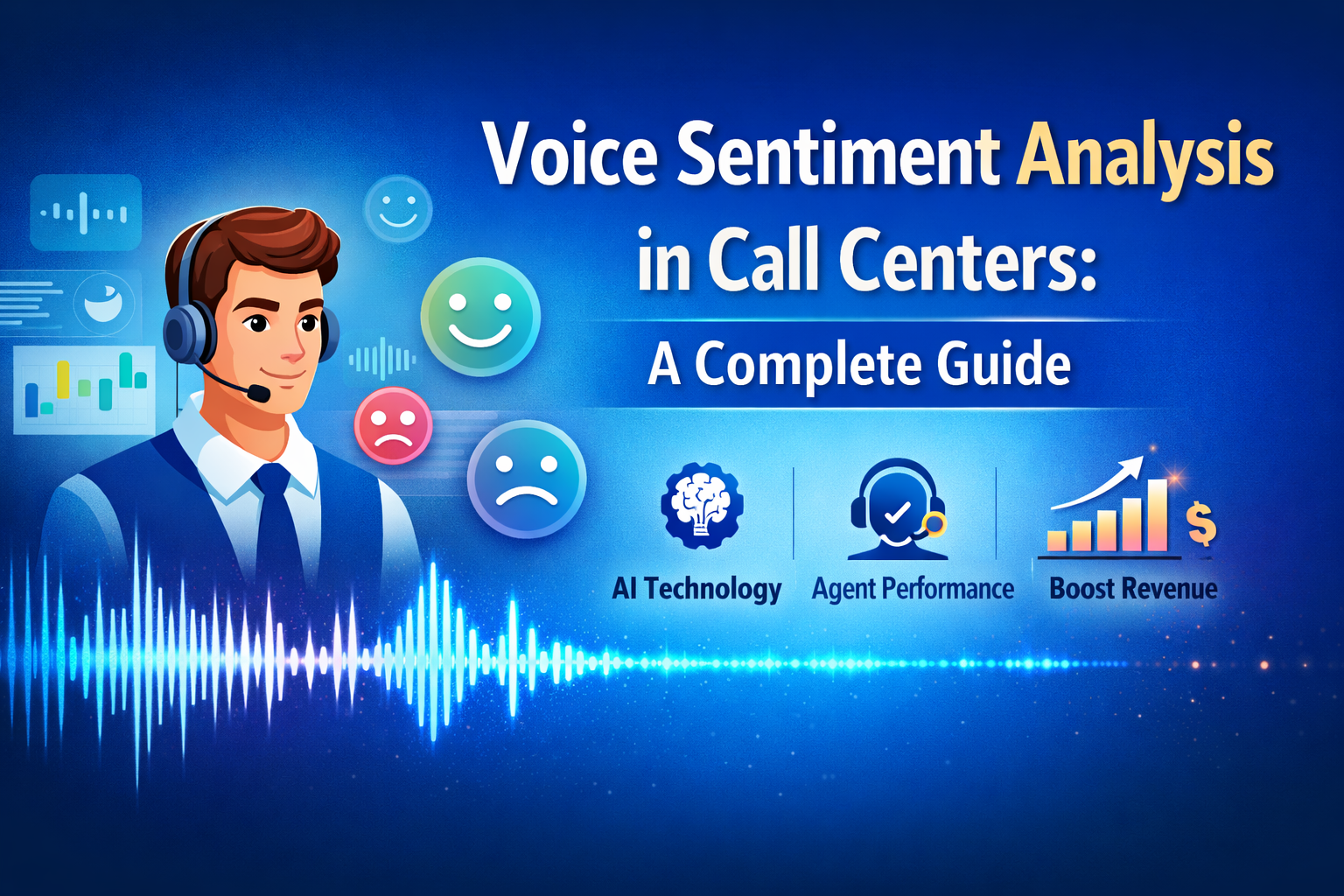

Voice Sentiment Analysis In Call Centers: A Complete Guide
Voice sentiment analysis has rapidly evolved from an experimental analytics feature into a core capability for enterprise call centers. As customer interactions become more complex, emotionally charged, and outcome-driven, understanding what customers feel during a call is no longer optional. Voice sentiment analysis enables call centers to decode emotion directly from speech, helping organizations move beyond surface-level metrics and toward deeper conversational intelligence.
In this complete guide, we will explore voice sentiment analysis in call centers in detail. We will cover what voice sentiment analysis is, how it works, why it matters, key use cases, benefits, implementation challenges, best practices, ROI measurement, and future trends. This guide is designed for CX leaders, operations heads, AI leaders, and decision-makers evaluating voice sentiment analysis as a strategic investment.
What Is Voice Sentiment Analysis
Voice sentiment analysis is the process of identifying emotional tone, attitude, and intent from spoken conversations using artificial intelligence. Unlike text-based sentiment analysis, voice sentiment analysis examines how something is said, not just what is said. It analyzes vocal signals such as pitch, speed, pauses, volume changes, and stress patterns to infer emotion.
In call centers, voice sentiment analysis evaluates live or recorded calls to determine whether a customer is frustrated, angry, confused, satisfied, calm, or distressed. Voice sentiment analysis can also assess agent tone, confidence, and empathy, making it equally valuable for agent performance management.
Voice sentiment analysis is especially powerful in spoken conversations because customers often mask dissatisfaction in words while revealing it through tone. This makes voice sentiment analysis significantly more accurate than text-only approaches in call center environments.
Why Voice Sentiment Analysis Is Critical For Call Centers
Call centers are emotional environments. Customers reach out when something is wrong, urgent, or confusing. Traditional call center metrics such as average handle time, call duration, and first call resolution measure efficiency but fail to capture emotional outcomes.
Voice sentiment analysis fills this gap by adding emotional intelligence to call center operations. With voice sentiment analysis, organizations can understand whether customers leave conversations satisfied or frustrated, regardless of how quickly the call ended.
In industries such as banking, insurance, telecom, healthcare, and utilities, negative sentiment during calls often correlates with churn, compliance risk, or financial loss. Voice sentiment analysis allows call centers to identify these risks early and intervene proactively.
At scale, voice sentiment analysis transforms call centers from reactive service functions into predictive intelligence engines.
How Voice Sentiment Analysis Works In Call Centers
Voice sentiment analysis relies on a layered AI architecture designed to process raw audio, extract signals, and generate actionable insights.
The first layer captures call audio in real time or from recordings. This audio is processed through automatic speech recognition systems to convert speech into text while preserving speaker separation and timestamps.
The second layer analyzes acoustic features. Voice sentiment analysis models evaluate pitch variation, speaking rate, intensity, silence duration, interruptions, and vocal stress. These features often carry emotional information independent of language.
The third layer applies natural language understanding to the transcribed text. This layer identifies sentiment polarity, intent, emotional keywords, and conversational context.
The final layer fuses acoustic and linguistic insights into a unified sentiment score. Advanced voice sentiment analysis platforms also track sentiment progression across the call timeline, showing how emotions rise or fall during specific moments.
This combination makes voice sentiment analysis far more reliable than text sentiment analysis alone.
Real-Time Voice Sentiment Analysis vs Post-Call Analysis
Voice sentiment analysis can operate in real time or after the call ends, depending on business objectives.
Real-time voice sentiment analysis monitors emotion during live calls. When frustration or anger spikes, supervisors can be alerted, scripts can adapt, or escalation workflows can trigger immediately. This is particularly valuable for high-risk interactions such as collections, cancellations, or regulatory conversations.
Post-call voice sentiment analysis focuses on analytics, quality assurance, and training. It processes large volumes of recorded calls to identify trends, recurring issues, agent behavior patterns, and customer pain points.
Most mature call centers use both approaches. Real-time voice sentiment analysis improves immediate outcomes, while post-call voice sentiment analysis drives continuous optimization.
Key Use Cases Of Voice Sentiment Analysis In Call Centers
Voice sentiment analysis delivers value across multiple call center functions, not just customer support.
In customer service, voice sentiment analysis identifies dissatisfied customers early, allowing faster resolution and proactive escalation. This reduces churn and repeat calls.
In collections, voice sentiment analysis helps agents adjust tone and strategy based on borrower stress or resistance. This improves recovery rates while maintaining compliance and empathy.
In sales and lead qualification, voice sentiment analysis detects buying intent, hesitation, or confidence, enabling agents to time their pitch more effectively.
In quality assurance, voice sentiment analysis replaces manual call sampling with automated evaluation across one hundred percent of calls.
In agent training, voice sentiment analysis provides objective feedback on empathy, tone, and conversational effectiveness, accelerating skill development.
Business Benefits Of Voice Sentiment Analysis
The most immediate benefit of voice sentiment analysis is improved customer experience. Customers respond positively when agents recognize emotional cues and adapt their responses accordingly.
Voice sentiment analysis also improves agent productivity. Agents receive real-time guidance and post-call insights that help them self-correct and improve performance.
Operationally, voice sentiment analysis reduces escalations, repeat calls, and complaints. It improves first call resolution by aligning responses with emotional context.
From a leadership perspective, voice sentiment analysis provides visibility into systemic issues. Leaders can identify which products, policies, or processes consistently generate negative sentiment.
In revenue-generating functions, voice sentiment analysis increases conversion rates by aligning conversations with customer readiness and emotional state.
Voice Sentiment Analysis In Multilingual Call Centers
Modern call centers operate across multiple languages and regions. Voice sentiment analysis must therefore work across accents, dialects, and cultural nuances.
Acoustic signals such as pitch, speed, and stress are often language-independent, making voice sentiment analysis inherently scalable. When combined with multilingual speech recognition, voice sentiment analysis delivers consistent insights across geographies.
This makes voice sentiment analysis especially valuable for global enterprises and outsourcing environments.
Challenges In Implementing Voice Sentiment Analysis
Despite its benefits, voice sentiment analysis presents several challenges.
Audio quality can affect accuracy. Background noise, cross talk, and poor call recordings require robust speech processing models.
Bias is another concern. Voice sentiment analysis models must be trained on diverse datasets to avoid misinterpreting accents or speech patterns.
Data privacy and compliance are critical. Voice sentiment analysis systems must align with regulations such as GDPR, HIPAA, and industry-specific guidelines.
Integration complexity can also slow adoption. Voice sentiment analysis must integrate seamlessly with existing call center platforms, CRMs, and analytics systems.
Best Practices For Deploying Voice Sentiment Analysis
Successful deployment of voice sentiment analysis starts with clear goals. Organizations must define whether the primary objective is CX improvement, revenue optimization, compliance, or a combination.
Choosing the right deployment model is essential. Cloud-based voice sentiment analysis offers scalability, while on-premise or private deployments offer greater control for regulated industries.
Continuous model tuning is critical. Voice sentiment analysis models must adapt to industry-specific language, seasonal behaviour, and evolving customer expectations.
Equally important is change management. Agents and supervisors must trust voice sentiment analysis insights. Transparency and training drive adoption.