

What Is Retrieval Augmented Generation (RAG)?

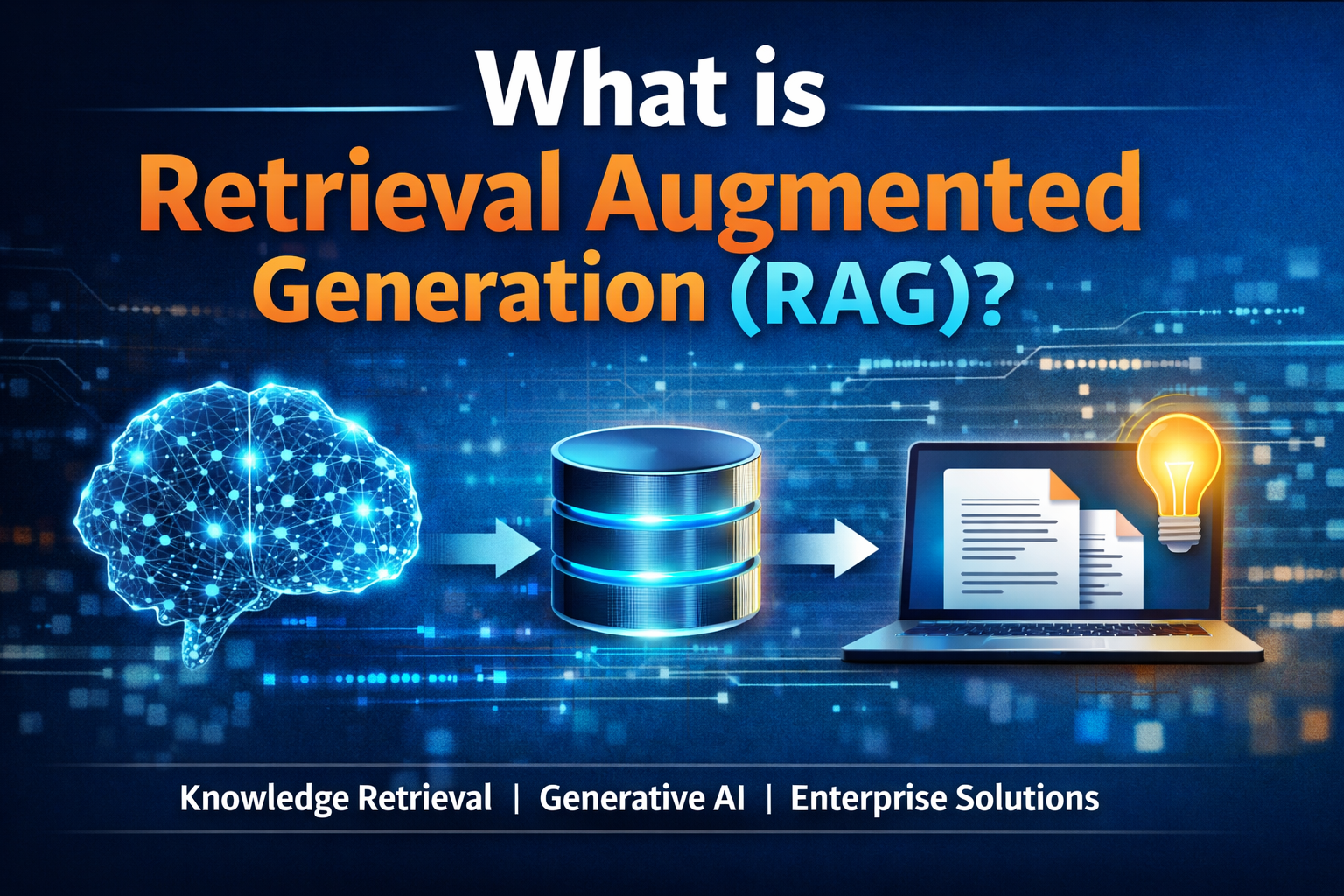

What Is Retrieval Augmented Generation (RAG)?
Artificial intelligence has moved fast. But enterprise adoption has moved cautiously. The reason is not lack of ambition. The reason is trust, accuracy, and control. This is exactly where retrieval augmented generation becomes critical.
Large language models are powerful. They can write, summarize, reason, and converse. But by themselves, they operate in isolation from your business data. They do not know your policies, your documentation, your customer history, or your internal knowledge base. This gap is where hallucinations happen. This gap is where enterprise AI breaks.
Retrieval augmented generation is the architectural breakthrough that closes this gap.
In this blog, we will break down what retrieval augmented generation is, why it matters, how it works, where it is used, and why it has become the default foundation for enterprise-grade generative AI systems.
Understanding the Core Problem with Traditional LLMs
Before understanding retrieval augmented generation, it is important to understand the limitation it solves.
Traditional large language models are trained on massive public and licensed datasets. Once training is complete, the model’s knowledge is frozen. It cannot natively access your databases, internal documents, product manuals, CRM systems, or policy repositories.
This leads to four major enterprise risks:
- Responses that sound confident but are factually incorrect
- Outdated information with no real-time context
- No grounding in proprietary or regulated data
- Limited explainability and traceability
For consumer use cases, this may be acceptable. For BFSI, healthcare, telecom, government, or SaaS platforms, this is unacceptable.
This is exactly why retrieval augmented generation was introduced.
What Is Retrieval Augmented Generation?
Retrieval augmented generation is a generative AI architecture that combines two systems working together.
The first system retrieves relevant information from an external knowledge source.
The second system uses a language model to generate a response grounded in that retrieved information.
In simple terms, retrieval augmented generation allows an AI model to “look up” facts before answering.
Instead of relying only on what the model learned during training, retrieval augmented generation injects real, contextual, enterprise-approved data into the prompt at runtime.
This makes responses more accurate, auditable, and business-aligned.
Why Retrieval Augmented Generation Matters for Enterprises
Retrieval augmented generation is not a feature. It is an architectural necessity.
Enterprises operate on dynamic data. Policies change. Product catalogs evolve. Regulations update. Customer interactions are contextual.
Without retrieval augmented generation, generative AI becomes risky at scale.
With retrieval augmented generation, AI becomes:
• Grounded in factual data
• Aligned with enterprise knowledge
• Safer for regulated industries
• Easier to govern and audit
• Faster to deploy without retraining models
This is why most serious enterprise AI platforms today are built around retrieval augmented generation by default.
How Retrieval Augmented Generation Works Step by Step
To understand retrieval augmented generation clearly, let us break it down into a practical flow.
Step 1: Data Ingestion and Indexing
Enterprise data is first ingested from sources such as PDFs, documents, databases, CRM systems, FAQs, call transcripts, or knowledge bases.
This data is then chunked and converted into vector embeddings using an embedding model.
These embeddings are stored in a vector database.
This step ensures your internal knowledge is searchable in semantic form.
Step 2: Query Understanding
When a user asks a question, the query is converted into an embedding.
This embedding represents the intent and meaning of the question.
Step 3: Retrieval
The system searches the vector database for the most relevant chunks of information based on semantic similarity.
Only the top, most relevant results are selected.
This retrieval step is the heart of retrieval augmented generation.
Step 4: Augmented Prompt Creation
The retrieved content is injected into the prompt along with the user query.
The language model is instructed to answer using only the provided context.
This ensures the output stays grounded in enterprise data.
Step 5: Generation
The language model generates a response using the retrieved information.
The result is a contextual, accurate, and enterprise-safe answer.
This entire pipeline is what defines retrieval augmented generation.
Retrieval Augmented Generation vs Fine-Tuning
A common question enterprises ask is whether retrieval augmented generation replaces fine-tuning.
The answer is simple. They solve different problems.
Fine-tuning teaches a model how to behave.
Retrieval augmented generation teaches a model what to know.
Fine-tuning is expensive, slow, and static.
Retrieval augmented generation is dynamic, scalable, and cost-efficient.
For most enterprise use cases, retrieval augmented generation delivers faster ROI with lower risk.
This is why retrieval augmented generation is preferred for customer support, compliance, analytics, and operational workflows.
Key Benefits of Retrieval Augmented Generation
Retrieval augmented generation delivers measurable business value.
Accuracy and Reduced Hallucinations
By grounding responses in retrieved data, retrieval augmented generation significantly reduces hallucinations.
The model no longer guesses. It responds based on facts.
Real-Time Knowledge Updates
Because retrieval augmented generation pulls data at runtime, updates reflect immediately.
No retraining required.
Enterprise Data Security
Data remains within enterprise systems.
Only relevant snippets are passed to the model.
This aligns with security and compliance requirements.
Explainability and Auditability
Responses can be traced back to source documents.
This is critical for regulated industries.
Faster Deployment Cycles
Retrieval augmented generation allows enterprises to deploy AI systems in weeks, not months.
Common Use Cases of Retrieval Augmented Generation
Retrieval augmented generation is already powering real-world enterprise systems.
Customer Support and Contact Centers
AI agents use retrieval augmented generation to answer customer queries based on internal knowledge bases, policy documents, and historical tickets.
This improves first-contact resolution and reduces agent dependency.
Sales Enablement
Sales teams use retrieval augmented generation to query product documentation, pricing, competitive intelligence, and proposals in real time.
Compliance and Risk Management
Retrieval augmented generation enables AI systems to answer compliance queries using approved regulatory documents and internal SOPs.
Enterprise Search
Internal teams use retrieval augmented generation as a conversational interface over enterprise data silos.
Analytics and Insights
AI systems retrieve structured and unstructured data, then generate insights using retrieval augmented generation.
Architecture Considerations for Retrieval Augmented Generation
Building retrieval augmented generation systems requires thoughtful design.
Key components include:
• High-quality data ingestion pipelines
• Efficient vector databases
• Robust chunking and metadata strategies
• Secure access controls
• Prompt orchestration and grounding rules
Poor implementation leads to poor retrieval.
Good retrieval leads to reliable generation.
Retrieval augmented generation is only as strong as the data strategy behind it.
Challenges with Retrieval Augmented Generation
While powerful, retrieval augmented generation is not plug and play.
Common challenges include:
• Poor document chunking
• Low-quality embeddings
• Irrelevant retrieval results
• Prompt leakage
• Latency at scale
These challenges are solvable with the right architecture and operational discipline.
Enterprises that invest early in retrieval quality outperform those that treat it as an afterthought.
The Future of Retrieval Augmented Generation
Retrieval augmented generation is evolving rapidly.
Future systems will include:
• Multi-modal retrieval across text, voice, images, and video
• Real-time streaming retrieval
• Memory-aware retrieval augmented generation
• Agentic workflows powered by retrieval augmented generation
• Deeper integration with enterprise APIs
As AI moves from chat to action, retrieval augmented generation will remain the backbone.
Why Retrieval Augmented Generation Is the Default Enterprise Standard
The industry has moved past experimentation.
Enterprises now demand:
• Accuracy
• Control
• Governance
• ROI
Retrieval augmented generation delivers all four.
This is why retrieval augmented generation is no longer optional. It is foundational.
Any enterprise deploying generative AI without retrieval augmented generation is accepting unnecessary risk.
Final Thoughts
Retrieval augmented generation is not just a technical concept. It is a strategic enabler.
It allows enterprises to scale AI safely, responsibly, and effectively.
It bridges the gap between generic intelligence and business-specific intelligence.
If you are serious about deploying generative AI in production, retrieval augmented generation is where you start.
If you are evaluating generative AI for your enterprise and want to implement retrieval augmented generation the right way, now is the time to act.
Talk to our AI experts to design a production-grade retrieval augmented generation architecture tailored to your data, workflows, and compliance needs.
Build AI systems that are accurate, reliable, and enterprise-ready.
Get started today.


