

What makes KYC verification voice AI a high impact feature?

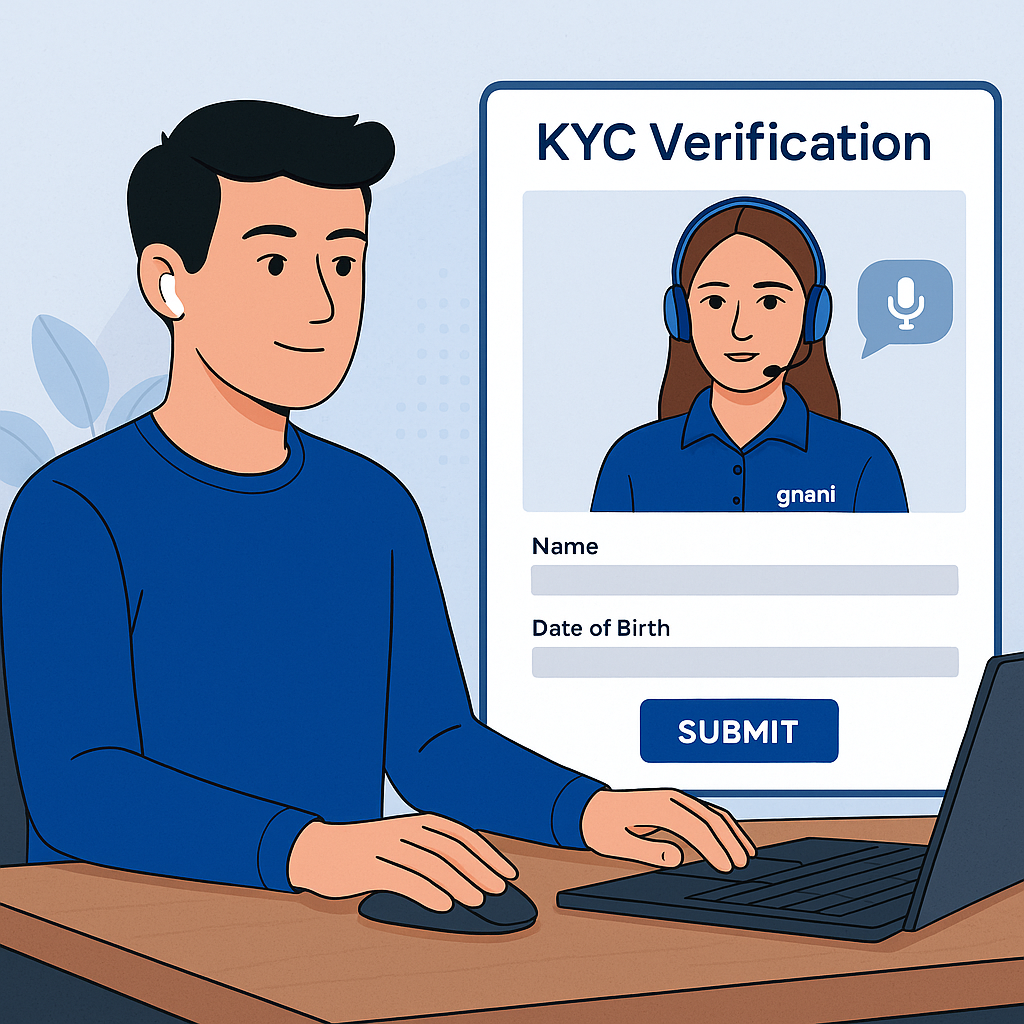

KYC verification voice AI is high impact because it automates identity verification conversations with high accuracy, ensures consistent regulatory compliance, and reduces manual workloads. It eliminates delays, reduces errors, and allows businesses in regulated industries to verify customers at scale without compromising security or CX.
Introduction: Why KYC verification voice AI matters now for decision makers
KYC verification voice AI has become one of the most critical levers for regulated industries as customer onboarding complexity grows and compliance demands intensify. Banks, insurers, fintech platforms, and digital lenders handle thousands of identity verification calls every day. Manual verification teams face rising operational costs, inconsistent accuracy, and frequent compliance gaps that expose the organization to regulatory risks.
As fraud patterns evolve and digital adoption accelerates, voice based KYC verification offers a faster, more controlled, and more compliant path. It enables organizations to verify identities, capture consent, and complete regulatory checks in real time, without long wait times or manual errors.
This article breaks down what KYC verification voice AI is, how it works, why most implementations fail, and what high performing organizations do differently. It also includes a real world case study to illustrate measurable business impact.
What is KYC verification voice AI?
KYC verification voice AI is an intelligent system that conducts identity verification over a live or automated voice conversation. It captures customer details, validates information through backend systems, identifies inconsistencies, and ensures every interaction adheres to regulatory standards.
At its core, it combines:
- Real time speech recognition
- Understanding of customer intent
- Identity verification workflows
- Secure system integrations
- Automated compliance prompts and checks
A simple way to think about it:
It is a trained digital compliance officer that speaks with customers, verifies who they are, and triggers the right backend actions without requiring a human agent.
How this differs from the old way
Traditional verification relied on:
- Manual agent calls
- Rules based IVR flows
- Scripted chatbots
- Human led cross checks
These approaches break under scale, produce inconsistent results, and lead to elevated compliance risks. Voice AI replaces rigid scripts with adaptive understanding, meaning the system can follow the verification flow even if customers respond in unpredictable ways.
The new model shifts from “agents reading static checklists” to “an intelligent voice agent dynamically completing verification workflows.”
Why most companies get KYC automation wrong
Common misconceptions and failure patterns
Most KYC automation failures can be traced to two misaligned assumptions:
- Treating KYC as a simple question–answer flow
In reality, KYC involves identity validation, consent capture, cross referencing data, and detecting anomalies. - Relying on generic conversational tools
Systems without domain grounding or compliance guardrails create unpredictable responses and audit failures.
Operational failures usually include:
- Misinterpretation of customer responses
- Missed compliance statements
- Incomplete data capture
- Incorrect document or ID checks
- Errors in backend integration flows
Risks to CX, compliance, and ROI
Without structured workflows and domain trained models, organizations face:
- Regulatory penalties
- Failed audits
- High abandonment rates
- Long onboarding times
- Inconsistent customer experiences
- Repetitive manual re-verification
KYC verification voice AI eliminates these risks by enforcing consistent, real time compliance while maintaining a natural, conversational flow.
How KYC verification voice AI works under the hood
High level architecture or workflow
The workflow typically includes 5 to 6 core components:
- Speech capture and transcription – Captures customer voice input with high accuracy.
- Intent and entity understanding – Extracts customer responses and identifies critical details.
- Compliance logic engine – Ensures the conversation adheres to regulatory flows.
- Identity verification layer – Validates against documents, CRM, or KYC databases.
- Orchestration and decisioning – Executes next steps or triggers follow up workflows.
- Audit and analytics – Logs every step for audit readiness.
Role of models, data, integrations, and guardrails
Models must:
- Understand domain specific phrases
- Support multilingual responses
- Detect incomplete or ambiguous statements
- Validate customer intent and details
Guardrails ensure that:
- Mandatory disclosure statements are never skipped
- Identity checks follow strict order
- Sensitive data is masked
- Interactions are stored for audits
Reliability, latency, security, and observability considerations
High performance systems offer:
- Low latency responses
- Encrypted voice and data channels
- Full conversation observability
- Version control for compliance flows
- Realtime monitoring of verification accuracy
Organizations must be able to audit, trace, and reproduce every KYC transaction.
Real world case study - Leading life insurer improves renewals and compliance using automated outreach
Background and challenge
A leading Indian life insurer needed to streamline policy renewals, KYC-driven outreach, and operational workflows. Manual processes caused delays, missed reminders, and high operational costs. Compliance tracking for large scale renewal communication was time consuming.
Solution design - how Voice AI was implemented
The organization automated over 800,000+ renewal calls, including KYC prompts and compliance statements. Voice AI reminders were deployed for KYC-related follow ups, policy renewals, and multi channel outreach.
Dashboards tracked customer intent, enabling more accurate renewal predictions and compliance monitoring.
Results and business impact
The deployment delivered:
- INR 95 lakh additional monthly revenue
- 59 percent reduction in operational expenses
- 15.4x ROI
These results highlight how voice led identity and compliance interactions help improve retention and reduce manual verification costs at scale.
Use cases and applications across industries
Banking and Finance
- Customer onboarding verification
- Loan application KYC checks
- Regulatory re verification cycles
Insurance
- Policy issuance verification
- Renewal compliance checks
- Consent and declaration capture
Fintech, lending apps, and BPO
- Instant identity confirmation
- Fraud risk mitigation
- Automated KYC for high volume customer segments
ROI and business impact
Cost reduction, efficiency, and scale metrics
Below is an example of how a voice based verification system improves cost and efficiency:
Revenue, upsell, and retention impact
Faster and accurate KYC removes friction from onboarding and policy renewals, directly improving revenue capture cycles.
CX and compliance improvements
Voice AI ensures:
- Consistent scripts
- Zero missed disclosures
- Faster verification
- Better customer experience
Implementation roadmap, best practices, and pitfalls
Phased rollout blueprint
- Phase 1: Identify specific KYC flows
- Phase 2: Integrate identity sources
- Phase 3: Build voice workflows
- Phase 4: Run controlled pilots
- Phase 5: Scale to full customer base
Governance, data, and evaluation best practices
- Maintain audit logs
- Continuously test compliance logic
- Monitor accuracy across languages
Common mistakes to avoid
- Using generic scripts
- No observability
- Poor integration with backend systems
Future outlook - where KYC verification voice AI is headed
Role of agentic AI, multimodal, and real time decisioning
Voice AI will evolve to:
- Perform proactive verification
- Cross check multiple data sources in real time
- Detect anomalies using behavioral signals
- Offer fully agentic compliance workflows
Regulatory and trust considerations
As regulations evolve, enterprises must use systems that are traceable, auditable, and transparent.
FAQ
How accurate is KYC verification voice AI?
Accuracy depends on domain trained models and structured workflows. Modern systems can achieve consistently high accuracy across languages when deployed with guardrails.
Can voice AI replace manual verification teams?
It reduces the workload significantly but is designed to complement manual teams for escalations and exceptions.
Is voice based verification compliant with regulations?
Yes, provided the system follows mandatory disclosures, captures consent, encrypts data, and provides audit logs.
Can it detect fraud attempts?
Voice AI detects inconsistent statements and unusual patterns and can be paired with additional layers for fraud detection.
What infrastructure is required?
Most deployments work with existing CRM, KYC databases, and telephony systems through APIs.
Conclusion
KYC verification voice AI has emerged as one of the highest impact capabilities for regulated industries. It delivers faster identity verification, stronger compliance, lower operational costs, and better customer experiences. As onboarding volumes grow and regulations tighten, organizations that adopt voice led KYC workflows now will be better positioned for resilience, scale, and regulatory trust.


